
WILLOUGHBY, R.: Freud’s British Family: Reclaiming Lost Lives in Manchester and London. London: Routledge, 2025, 254 p.

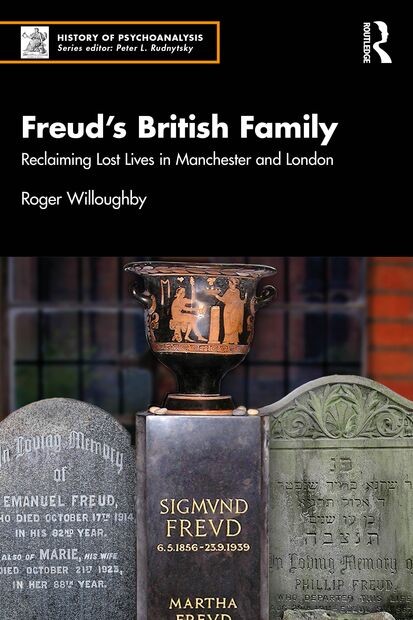
In recent decades, biographical research has increasingly turned towards peripheral voices and “shadow” figures – individuals long overlooked or systematically marginalised by traditional narratives and societal interest. These “lost stories” are no longer merely supplementary to grand biographies; rather, they often serve as keys to understanding complex identities, essential interconnections, and the intellectual processes that shape the human mind. Roger Willoughby’Freud’s British Family: Reclaiming Lost Lives in
Manchester and London fits naturally within this methodological and ideological trajectory. The book offers an original, interdisciplinary, ambitious, and culturally provocative contribution – not only to Freudian studies but also to the broader and deeper examination of the Jewish diaspora, the historical period of modernity, and questions of cultural-psychological identity. Willoughby’s text is meticulously structured: its chapters follow a clear developmental arc – from the genealogical origins of Sigmund Freud’s extended family, through the migratory movements of his half-brothers Emanuel and Philipp, to
Freud’s final months spent in exile in London, where he was forced to relocate in 1938 following the Nazi annexation of Austria. As a Jew, Freud faced escalating persecution: his daughter Anna was detained for several hours by the Gestapo, his books were publicly burnt, and psychoanalytic institutions were disbanded. His move to London was motivated not only by the political threat but also by his deteriorating health – he had long suffered from oral cancer, which required repeated surgeries and continuous medical care. Though physically weakened, Freud continued his intellectual work in London exile until he died in 1939. Roger Willoughby deliberately distances himself from the traditional biographical model that portrays Sigmund Freud as an isolated originator of psychoanalysis, detached from his social and familial context. Instead, he reconstructs neglected or actively suppressed connections that shaped Freud’s psychoanalytic thought – connections that have hitherto been marginalised or interpreted only indirectly. Willoughby’s principal focus lies with Freud’s much older half-brothers, Emanuel and Philipp – figures whom the historiography of psychoanalysis has largely left in obscurity, if acknowledged at all. He reconstructs their lives within the context of Victorian Britain, employing rich archival sources: business records, immigration documents, preserved correspondence, and church registers. The result is a detailed and rigorously executed microhistory that is not merely anecdotal; rather, it provides a foundation for analysing the deeper psychological, cultural, and symbolic dimensions of Freud’s work. The tension between intellectual and practical success, between the symbolic capital of Vienna and the material capital of Manchester, and between diasporic alienation and cultural adaptation emerges as a central theme of the book. One of the most compelling aspects of Willoughby’s interpretation is his analysis of Freud’s silence. With the subtlety characteristic of psychoanalytic reading, the author suggests that the absence of Freud’s brothers in his writings is neither coincidental nor insignificant. On the contrary, the silence becomes symptomatic. Freud’s reserved engagement with themes such as fraternal rivalry or identification with an elder sibling, despite their prominence in his theoretical framework, gains new depth when viewed against
the backdrop of his family history. Roger Willoughby interprets this discrepancy as a manifestation of psychological and cultural repression, drawing on classical Freudian concepts such as the return of the repressed, identification, and neurosis as the consequence of unintegrated memory. A notable feature of the publication is its interdisciplinarity. The author skilfully integrates genealogical research with cultural historiography, applied psychoanalysis, and postcolonial identity theory. In his reading, Emanuel and Philipp are not merely historical actors shaping Freud’s identity; they become powerful symbols of a hybrid Jewish identity, one that oscillates between multiple worlds and competing discourses. Their life trajectories in Britain offer a model of existence that contrasts not only with Freud himself but also with the dominant narratives of Jewish intellectual modernity. Through this lens, Roger Willoughby opens up a new space for reflecting on marginalised identities within the history of psychoanalysis – not as supplements, but as significant contexts for its emergence. In the concluding section of the book, the author examines the final months of Freud’s life in London, situating them within the wider constellation of his British family. He highlights the fragmented, incomplete, and perhaps ambivalent nature of Freud’s British identity, suggesting that it was his brothers who experienced this identity more fully, more naturally, and with greater rootedness. In doing so, the book reopens the question of the internal tension between cultural belonging and the personal experience of exile. Freud’s British Family: Reclaiming Lost Lives in Manchester and London is a substantial contribution not only to the biography of Sigmund Freud but also to wider debates on cultural memory, identity, and transmission within the Jewish diaspora. Through its combination of historical rigour, analytical depth, and cultural sensitivity, the book aspires to engage not only scholars but also a broader readership interested in Sigmund Freud, the history of psychoanalysis, migration studies, and Central European cultural identities in the British context.
Kontakt:
Mgr. Ingrid Baniatová
ÚMKTKE FF UKF v Nitre
Hodžová 1
949 01 Nitra
E-mail: ibaniatova@ukf.sk