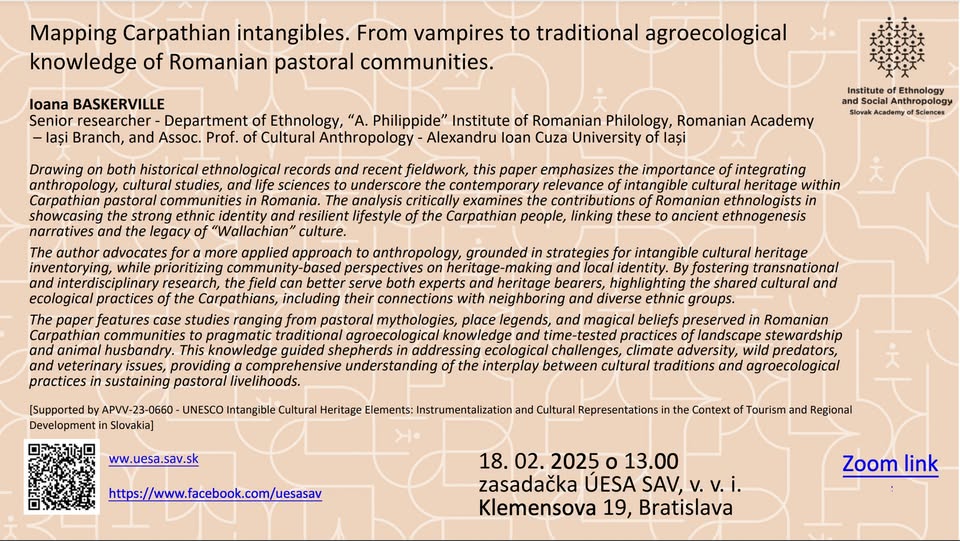
V rámci odborného seminára Vedeckej rady nášho ústavu si Vás dovoľujeme pozvať na prednášku v angličtine, ktorá sa uskutoční v utorok 18. februára 2025 od 13.00 v zasadačke ÚESA SAV na Klemensovej 19 v Bratislave. Vystúpi Ioana Baskerville, Senior researcher – Department of Ethnology, “A. Philippide” Institute of Romanian Philology, Romanian Academy – Iași Branch, and Associate Professor of Cultural Anthropology – Alexandru Ioan Cuza University of Iași, s prezentáciou na tému „Mapping Carpathian intangibles. From vampires to traditional agroecological knowledge of Romanian pastoral communities“ [viac informácií tu].
Odborný seminár sa uskutočňuje v rámci projektu APVV-23-0660 Prvky nehmotného kultúrneho dedičstva UNESCO: Inštrumentalizácia a kultúrne reprezentácie v kontexte turizmu a regionálneho rozvoja na Slovensku, ktorého riešiteľom je Ústav manažmentu kultúry a turizmu, kulturológie a etnológie, Filozofická fakulta, Univerzita Konštantína Filozofa v Nitre v spolupráci s Ústavom etnológiea sociálnej antropológie, v. v. i. SAV.
Anotácia
Drawing on both historical ethnological records and recent fieldwork, this paper emphasises the importance of integrating anthropology, cultural studies, and life sciences to underscore the contemporary relevance of intangible cultural heritage within Carpathian pastoral communities in Romania. The analysis critically examines the contributions of Romanian ethnologists in showcasing the strong ethnic identity and resilient lifestyle of the Carpathian people, linking these to ancient ethnogenesis narratives and the legacy of “Wallachian” culture. The author advocates for a more applied approach to anthropology, grounded in strategies for intangible cultural heritage inventorying, while prioritising community-based perspectives on heritage-making and local identity. By fostering transnational and interdisciplinary research, the field can better serve both experts and heritage bearers, highlighting the shared cultural and ecological practices of the Carpathians, including their connections with neighbouring and diverse ethnic groups. The paper features case studies ranging from pastoral mythologies, place legends, and magical beliefs preserved in Romanian Carpathian communities to pragmatic traditional agroecological knowledge and time-tested practices of landscape stewardship and animal husbandry. This knowledge guided shepherds in addressing ecological challenges, climate adversity, wild predators, and veterinary issues, providing a comprehensive understanding of the interplay between cultural traditions and agroecological practices in sustaining pastoral livelihoods.
[Supported by APVV-23-0660 – UNESCO Intangible Cultural Heritage Elements: Instrumentalization and Cultural Representations in the Context of Tourism and Regional Development in Slovakia]
Prednáška v rámci APVV „UNESCO.sk“